Table of Contents
Heard is an all-in-one financial, bookkeeping, and tax platform designed specifically for therapists and mental health professionals in private practice. It combines automated accounting software with human bookkeeping teams to manage monthly financial reports, quarterly tax estimates, and S-Corp elections. While it starts at $129/month, making it pricier than DIY software like QuickBooks, its therapy-specific tax deduction expertise saves practitioners significant time and money.
SECTION 1: Quick Verdict
After extensively evaluating the platform and analyzing hundreds of verified customer experiences, my professional consensus as a CPA and financial systems analyst is that Heard is currently the most robust, specialized accounting and tax solution available for independent mental health professionals.
For therapists transitioning from a messy combination of Excel spreadsheets, Shoeboxed receipts, and a generic local CPA who only speaks to them once a year, Heard is a revelation. It takes the guesswork out of quarterly taxes, maximizes therapy-specific deductions (like CEUs, supervision fees, and specialized licensing), and provides an accurate, real-time monthly Profit and Loss (P&L) statement.
However, it is not a perfect fit for everyone. The reliance on a messaging portal for support can frustrate users who prefer picking up the phone for instant advice. Additionally, for practitioners with complex, multi-state real estate investments or joint-filing spouses with highly complex corporate equity structures, Heard’s specialized focus on the therapy practice can feel restrictive.

Overall Rating: 4.4 / 5.0
Quick Verdict Table
| Category | Rating | Analyst Commentary |
| Ease of Use | 4.8/5 | Exceptionally clean onboarding; native integrations with practice management tools like SimplePractice. |
| Bookkeeping | 4.5/5 | Automated bank feeds combined with human review ensure year-end tax-ready books. |
| Tax Preparation | 4.6/5 | Superb at therapy-specific deductions and S-Corp strategy, though annual filing requires a premium tier or add-on. |
| Financial Reports | 4.5/5 | Monthly P&L statements and profit allocation guides are easy to read for non-accountants. |
| Support | 3.5/5 | Knowledgeable, but completely reliant on messaging/email. Lacks on-demand phone support. |
| Pricing | 4.0/5 | At $129/mo (Lite), it is an investment, but substantially cheaper than a traditional CPA retainer. |
| Automation | 4.3/5 | Excellent transaction categorization and automated quarterly tax payment reminders. |
| Value for Money | 4.4/5 | The time saved and the deductions found usually cover the cost of the software. |
Best For:
- Solo therapists running an LLC or sole proprietorship.
- Private practices looking to elect S-Corp status for tax savings.
- Mental health professionals struggling to track estimated quarterly taxes.
Not Recommended For:
- Therapists needing instant, on-demand phone support for complex financial crises.
- Those with incredibly complex non-therapy side businesses or joint filing structures.
- Practitioners earning under $30,000 annually where DIY software like QuickBooks Self-Employed is more economically viable.
SECTION 2: What Is Heard?

Heard is a financial back-office platform designed exclusively for therapists, counselors, psychologists, and social workers operating private practices. Founded with the specific mission to relieve the administrative burden of accounting from mental health professionals, the company combines automated bookkeeping software with a dedicated team of human financial experts.
Why Therapists Need Specialized Accounting
The business of therapy is unique. A generic bookkeeper rarely understands the nuances of sliding-scale revenue recognition, the cash flow impacts of insurance reimbursement delays, or the specific deductibility of clinical supervision and mandatory Continuing Education Units (CEUs). Traditional CPAs are often too expensive for a solo practitioner, while DIY software like Wave or FreshBooks leaves the therapist responsible for calculating their own complex quarterly estimated taxes—often leading to IRS penalties.
How Heard Works
Heard bridges this gap. Once you connect your business bank accounts and practice management software (like SimplePractice or TherapyNotes), the platform automatically pulls in transaction data. Heard’s algorithm categorizes the bulk of these transactions, while a dedicated human bookkeeping team reviews the ledger for accuracy, reconciles the accounts, and generates a clean monthly financial statement.
Unlike a traditional accountant who only looks at your books in April, Heard provides year-round financial visibility. This proactive approach ensures that estimated taxes are paid correctly every quarter, preventing a massive, unexpected tax bill at the end of the year.
SECTION 3: Core Features
To understand whether Heard justifies its price tag, we must dissect the platform’s core features. The service is not just software; it is a hybrid model of SaaS (Software as a Service) and professional financial services.
Done-For-You Bookkeeping
Heard completely offloads the task of reconciling bank statements. You link your business checking, savings, and credit cards via a secure integration. The system tracks every expense and categorizes it accurately. If the system flags an ambiguous purchase, it prompts you via the dashboard to define it, ensuring your books remain tax-ready year-round.
Monthly Financial Reports & Business Dashboard
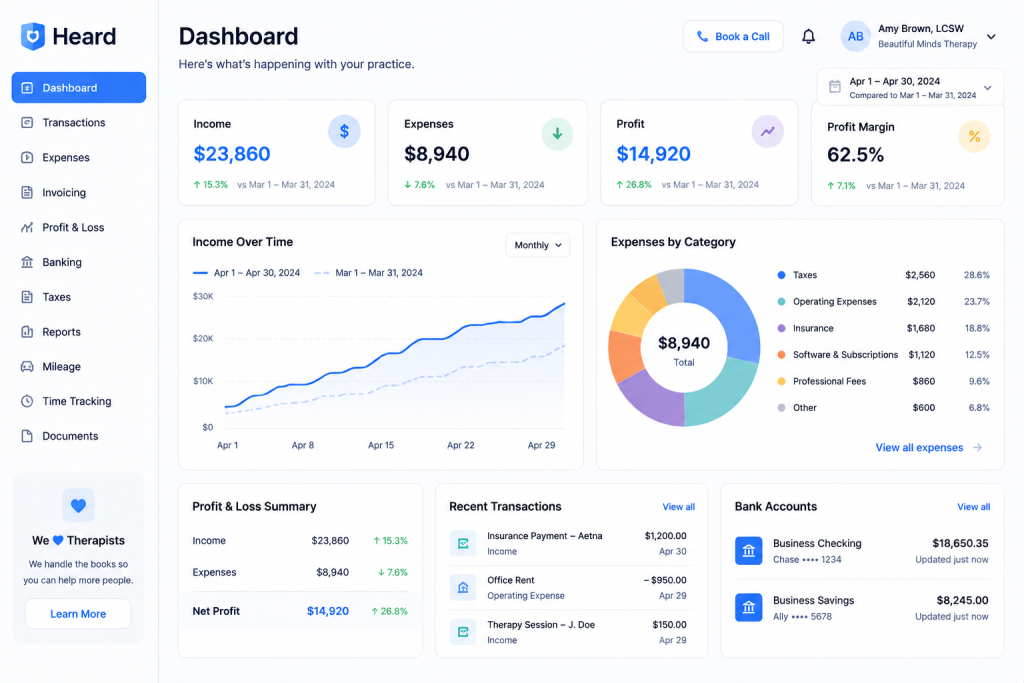
Every month, users receive a standard Profit and Loss (P&L) statement alongside a visual business dashboard. This tracks your income in real-time, monitors progress toward your annual revenue goals, and provides a “Profit Allocation Guide” to help you determine exactly how much cash you should distribute to taxes, personal savings, and business reinvestment.
Tax Preparation & Quarterly Estimates
This is arguably Heard’s highest-value feature. Most independent contractors get burned by quarterly taxes. Heard analyzes your real-time revenue and calculates your exact state and federal estimated tax liability. The platform notifies you when payments are due and provides step-by-step guidance on how to remit the payments directly to the tax authorities. For users on the higher tiers, Heard handles the complete year-end federal and state tax filing (both business and personal).
Business Entity & S-Corp Guidance
As a private practice grows, operating as a sole proprietor becomes tax-inefficient. Heard provides a personalized readiness report to determine if electing S-Corporation status makes financial sense. If it does, Heard handles the paperwork (Form 2553) to elect S-Corp status with the IRS and guides you through the necessary payroll requirements to remain compliant.
Payroll Guidance
Through a native integration with Gusto, Heard offers an optional payroll add-on. This is critical for S-Corps, as the IRS mandates that owners take a “reasonable salary” via W-2. Heard automates the payroll processing, ensuring that payroll taxes are withheld and remitted correctly.
Document Storage & Security
The platform features bank-level encryption for all synced financial data. It also serves as a centralized vault for your most important financial documents, past tax returns, and IRS correspondence, keeping you audit-ready at all times.
SECTION 4: AI & Automation

While Heard relies heavily on its human experts, its software architecture utilizes modern AI and automation to keep costs down and improve accuracy.
Automated Workflows
The heaviest lifting is done by the platform’s automated bank feed syncs. Once a transaction clears your bank, Heard’s rules engine immediately attempts to categorize it based on vendor data and historical patterns. This drastically reduces the hours a therapist would normally spend doing manual data entry.
AI Assistant & Knowledge Base
Heard incorporates smart search and an AI-assisted knowledge base to help practitioners find immediate answers to standard tax questions (e.g., “What is the standard mileage rate for 2026?”).
Current AI Limitations & Future Potential
Currently, the AI does not provide complex, personalized advisory services. If you ask the platform a highly nuanced question about depreciation on an inherited commercial property, the system will route the query to a human CPA. In the future, we anticipate Heard will integrate more predictive AI to forecast revenue dips based on seasonal therapy trends (such as the typical summer slump).
SECTION 5: User Experience
Accounting software is traditionally clunky, intimidating, and filled with jargon. Heard strips this away entirely.
Signup and Onboarding
The onboarding process is highly structured. You are not just thrown into a blank software interface. Heard provides group onboarding webinars (“Today at Heard”) to ensure your accounts are linked properly from day one. The platform provides a clear checklist: link your bank, upload last year’s tax return, and connect your payment processor (Stripe, Square, etc.).
Dashboard Navigation
The user interface is minimalist. The left-side navigation cleanly separates Bookkeeping, Taxes, Payroll, and Support. The language used throughout the dashboard is plain English, avoiding overly technical accounting terms unless absolutely necessary.
Mobile vs. Desktop Experience
Heard is primarily optimized for desktop use, which aligns with how most business owners review their finances. The mobile web experience is functional for checking balances or uploading a receipt, but deep-dive P&L reviews are best done on a laptop. The learning curve is virtually non-existent because the software limits what you can do—it prevents you from accidentally breaking your own ledger.
SECTION 6: Pricing
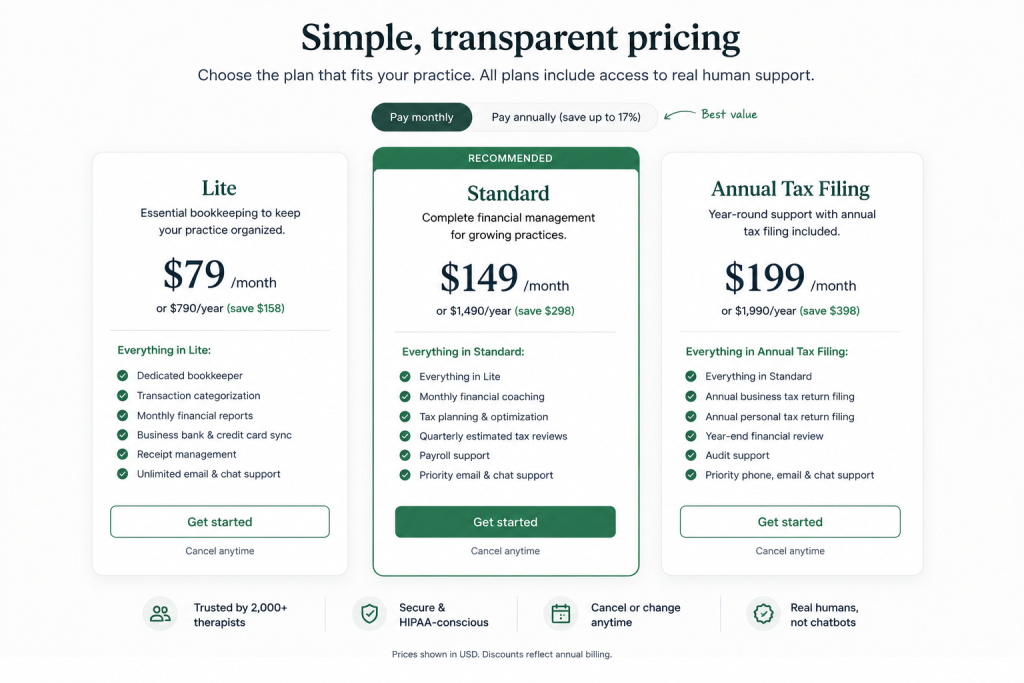
Heard’s pricing model reflects its status as a premium, specialized service. While it is more expensive than a basic QuickBooks subscription, it replaces both the software and the human bookkeeper. It is important to note that Heard offers a 15% discount for annual billing on most plans.
Pricing Comparison Table
| Plan Name | Monthly Cost (Annual Billing) | Best For | Core Inclusions | Missing Features |
| Heard Lite | $129/mo ($1,548/yr) | Sole proprietors just starting out. | Monthly bookkeeping, P&L reports, Quarterly tax estimates. | Does not include annual tax return filing ($750 one-off fee). |
| Heard Essential | $149/mo (approx.) | Established solo therapists. | Bookkeeping, quarterly estimates, basic support. | Year-end tax filing. |
| Heard Standard / Core | $209/mo (approx.) | High-earning sole props or LLCs. | Everything in Essential + Year-end federal & state tax returns. | Dedicated CFO advisory. |
| Heard Premium | $299/mo (approx.) | Growing group practices. | S-Corp election, dedicated CFO-level advisor, complex returns. | Payroll (requires add-on). |
Optional Add-Ons:
- Payroll: Powered by Gusto, this costs a base fee of $39/month plus $6 per employee/contractor per month.
- Catch-Up Bookkeeping: If you are months behind on your books, Heard will retroactively clean up your ledger for a one-time onboarding fee.
ROI Analysis:
For a therapist billing $100,000 a year, the roughly $2,500 annual cost of a mid-tier Heard plan is easily offset by the time saved. If a therapist values their time at $150 per hour and previously spent 5 hours a month on bookkeeping, they are saving $9,000 in billable opportunity cost per year. Furthermore, the S-Corp tax strategy can routinely save practitioners between $3,000 and $7,000 annually in self-employment taxes.
SECTION 7: Performance
In financial software, performance is measured by accuracy, compliance, and reliability.
Bookkeeping Accuracy & Tax Workflow
Because Heard utilizes human oversight to verify automated categorization, the accuracy of the P&L statements is incredibly high. The tax workflow is equally impressive; the platform seamlessly transitions your monthly data into a Schedule C or Form 1120-S format, drastically reducing the friction of tax season.
Speed and Reliability
The dashboard updates reliably based on bank feed refresh rates (typically 24 to 48 hours after a transaction clears). The platform itself suffers from virtually zero downtime, hosted on secure, enterprise-grade cloud infrastructure.
Security
Security is paramount when dealing with both financial data and healthcare professionals. While Heard handles financial data (not direct PHI/clinical notes), it utilizes AES-256 encryption, multi-factor authentication (MFA), and secure API protocols for all bank connections.
SECTION 8: Customer Reviews
To provide an objective review, we analyzed feedback across Trustpilot, Reddit, and independent CPA forums. Heard currently holds an impressive 4.2/5 rating on Trustpilot.
Recurring Positive Themes:
- Relief from Anxiety: The most common sentiment is sheer relief. Users consistently state that outsourcing their finances allows them to “focus on patient care” rather than stressing over the IRS.
- Therapy-Specific Knowledge: Therapists praise Heard for knowing exactly what can and cannot be deducted in a clinical practice, leading to larger-than-expected tax returns.
- Clean UI: Reviewers frequently highlight how easy the software is to read and understand, even for those with zero financial background.
Recurring Negative Themes:
- Communication Delays: The primary friction point is customer support. Several users on Reddit and Trustpilot expressed frustration that there is no inbound phone number to call for immediate help. Support is handled asynchronously via a messaging portal, and some users reported waiting over 48 hours for a response during peak tax season.
- Not for Complex Tax Situations: Users who have a spouse with complex W-2 stock options, or those who run multiple unrelated businesses (e.g., a therapy practice and an e-commerce store), found that Heard struggled to accommodate the non-therapy aspects of their joint tax returns.
SECTION 9: Customer Support
Heard’s support model is built for scale, which is a double-edged sword.
Available Channels:
- Messaging Portal: The primary method of communication.
- Group Webinars: Weekly “Today at Heard” sessions allow users to ask general questions live.
- Knowledge Base: A comprehensive library of articles tailored to private practice finance.
Support Quality:
When you do receive a response, the quality of the advice is exceptionally high. The team consists of trained bookkeepers and tax preparers who deeply understand the mental health industry. However, the strict reliance on asynchronous messaging means that if you receive an alarming letter from the IRS and are in a panic, you cannot simply dial a 1-800 number to speak with your accountant immediately. For some business owners, this lack of instant access is a dealbreaker.
SECTION 10: Pros & Cons
Pros & Cons Comparison Table
| Strengths (Pros) | Weaknesses (Cons) |
| Niche Expertise: Purpose-built for the unique tax needs of therapists. | No Phone Support: Completely reliant on messaging and email for customer service. |
| All-in-One Hub: Combines software, bookkeeping, and tax prep in one subscription. | Price: $129 – $299/mo is significantly more expensive than DIY software. |
| S-Corp Management: Handles the complex election and compliance of S-Corporations. | Inflexible for Side Hustles: Struggles with highly complex, non-therapy joint filing scenarios. |
| Automated Tax Estimates: Calculates and reminds you to pay quarterly taxes. | Onboarding Time: Initial setup and bank syncing requires dedicated time and attention. |
| Time Savings: Frees up hours of billable time previously spent in spreadsheets. | Limited Group Practice Scalability: Best for solos; massive clinics may outgrow it. |
SECTION 11: Heard vs Competitors
How does Heard stack up against the broader market of accounting tools and services?
Competitor Comparison Table
| Feature / Platform | Heard | Bench | QuickBooks Live | Collective | DIY (Wave/FreshBooks) |
| Target Audience | Therapists & Mental Health | General Small Business | General Small Business | Freelancers & Solopreneurs | Solopreneurs on a budget |
| Starting Price | $129/month | ~$299/month | ~$300/month | ~$299/month | Free to $30/month |
| Tax Filing Included? | Yes (on higher tiers) | Yes (Premium tier) | No (Separate product) | Yes | No |
| Industry Expertise | Extremely High | Low | Low | Medium | None (It’s just software) |
| S-Corp Support | Yes (Excellent) | Limited | Yes | Yes (Core feature) | No |
| Ease of Use | High | High | Medium | High | High |
| Overall Value | Best for Therapists | Good for Retail/Agencies | Best for complex inventory | Best for general freelancers | Best for brand new solos |
Heard vs Bench
Bench is a massive bookkeeping service, but it caters to everyone from plumbers to e-commerce stores. Bench’s generic bookkeepers will not inherently know the deductibility rules for clinical supervision. Heard wins easily for therapists.
Heard vs Collective
Collective is an excellent platform that focuses specifically on “Business of One” S-Corps. While Collective is a strong alternative, Heard’s specific integrations with therapy EHRs (Electronic Health Records) and deep knowledge of healthcare compliance gives it the edge in this specific niche.
Heard vs QuickBooks Self-Employed
If you make less than $30,000 a year, stick to QuickBooks. Heard’s monthly fee will eat up too much of your profit margin. However, as soon as you near the $80,000+ revenue mark and require S-Corp optimization, QuickBooks becomes a liability unless paired with an expensive local CPA.
SECTION 12: Best Use Cases
The Solo Therapist (LLC or Sole Proprietor)
This is Heard’s bread and butter. A therapist working 25 clinical hours a week does not have the energy to reconcile bank statements on Friday afternoon. Heard’s Lite or Essential plan ensures they capture every deduction without the headache.
The Growing Practice (Transitioning to S-Corp)
When a therapist hits around $80,000 to $100,000 in net income, the self-employment tax (15.3%) becomes punitive. Heard’s ability to run a personalized readiness report, file the Form 2553 to become an S-Corp, and set up Gusto payroll for a reasonable owner’s draw is an incredible value-add that justifies the software cost immediately.
Small Group Practices
For practitioners who have hired a few 1099 contractors or part-time W-2 clinicians, Heard’s premium tiers provide the financial visibility needed to determine profit margins per clinician, helping owners decide when it is safe to expand.
SECTION 13: Buying Guide
When Heard is 100% Worth It:
- You are generating over $50,000 in annual revenue.
- You dread tax season and have previously paid IRS late penalties.
- You currently pay a local CPA more than $2,500 a year for basic services.
- You want the tax advantages of an S-Corp but are terrified of the compliance paperwork.
When to Hire a Traditional CPA Instead:
- You require intense, face-to-face strategic advisory.
- You are filing jointly with a spouse who owns complex commercial real estate or has K-1s from multiple non-therapy partnerships.
- You demand immediate telephone support.
Questions to Ask Before Subscribing:
- Am I willing to switch my business banking to align with their integrations?
- Do I have the budget for the $129-$299 monthly fee?
- Am I comfortable communicating with my accounting team exclusively via a portal?
SECTION 14: Frequently Asked Questions
1. How much does Heard cost?
Heard starts at $129/month (billed annually) for the Lite plan, with higher-tier plans ranging from $149 to $299/month depending on tax filing and advisory needs.
2. Does Heard replace my CPA?
Yes. For most standard therapy practices, Heard’s higher tiers fully replace a traditional CPA by handling bookkeeping, quarterly estimates, and annual tax returns.
3. Does Heard do personal taxes?
Yes, on the Standard and Premium plans, Heard handles both your business and personal federal and state tax returns.
4. Is Heard HIPAA compliant?
Heard handles financial data, not clinical notes. While bank-level secure, it does not require a BAA for standard bookkeeping as it does not process Protected Health Information (PHI).
5. Can Heard help me become an S-Corp?
Absolutely. Heard evaluates your finances, files the IRS Form 2553 on your behalf, and manages the ongoing payroll requirements.
6. Does Heard integrate with SimplePractice?
Yes, Heard connects with popular EHRs like SimplePractice, TherapyNotes, and TheraNest to streamline revenue tracking.
7. Can I call Heard on the phone?
No. Heard utilizes an asynchronous messaging portal for support, alongside live group webinars. Direct ad-hoc phone support is not a standard feature.
8. What is Heard Lite?
Heard Lite ($129/mo) includes monthly bookkeeping and quarterly tax estimates, but does not include annual year-end tax filing (which costs $750 extra on this tier).
9. Does Heard include payroll?
Payroll is available as an integrated add-on via Gusto for a base fee of $39/month plus $6 per employee.
10. What if I am behind on my books?
Heard offers “Catch-Up Bookkeeping” for a one-time fee to get your historical data tax-ready before transitioning to monthly maintenance.
11. Is Heard good for group practices?
It is excellent for small to mid-sized group practices, but massive clinics with complex corporate structures may outgrow it.
12. Do I have to sign an annual contract?
You can pay month-to-month, but Heard offers a 15% discount for annual commitments.
13. Does Heard track my business expenses automatically?
Yes, by connecting to your business bank and credit card accounts, transactions are pulled in and categorized automatically.
14. Who owns Heard?
Heard is a venture-backed tech company, uniquely founded by an accountant who is married to a therapist, giving them specific insight into the industry.
15. Can Heard help if I am audited?
Heard maintains meticulously organized records and financial documents that are audit-ready, though representation during an audit may require specialized legal/tax counsel depending on the plan.
16. Does Heard handle state taxes?
Yes, Heard calculates quarterly estimates and annual returns for both federal and state taxes.
17. What if I have a side hustle outside of therapy?
If it is a small side hustle under the same entity, they can manage it. If it is a completely separate, complex business, Heard is not recommended.
18. How long does onboarding take?
Setup generally takes a few hours of work on your end to link accounts, followed by a review period by the Heard onboarding team.
19. What happens if I want to cancel?
You can export your financial data and reports at any time to hand over to a new CPA if you choose to leave the platform.
20. Is Heard worth the money?
For the vast majority of therapists grossing over $50,000, the time saved and tax deductions found make Heard highly cost-effective.
SECTION 15: Final Verdict
Heard has successfully identified a massive pain point in the healthcare industry and built a tailor-made solution to fix it. General-purpose accounting software requires too much manual effort, and traditional CPAs are often too generic and expensive.
By hyper-focusing on the specific needs of mental health professionals, Heard delivers exceptional value. The automated bookkeeping is accurate, the P&L statements provide critical business visibility, and their handling of S-Corp elections is worth the subscription price alone.
Key Strengths: Therapy-specific tax knowledge, seamless S-Corp management, automated bank syncing, and clean monthly reporting.
Weaknesses: Completely lacks on-demand phone support; premium pricing compared to DIY tools.
Who Should Buy: Solo therapists, growing private practices, and any mental health professional who loses sleep over quarterly taxes.
Who Should Skip: Therapists making very little revenue, or those with highly complex, non-therapy joint tax situations.
Best Alternatives: Bench (for non-therapists), Collective (for general freelancers), QuickBooks Self-Employed (for low-revenue DIYers).